

What Is Servo Spindle Press Technology?
Servo spindle press technology represents a major advancement in metal forming technology, combining the precision of servo drive systems with the force of traditional mechanical presses. Unlike conventional presses that rely on fixed flywheel energy and cam-driven motion profiles, a servo spindle press uses high-precision servo motors to control ram movement with exceptional accuracy and flexibility.
This technology enables manufacturers to program custom motion profiles, adjust forming speeds in real time, and achieve consistent results in complex metal stamping operations. The servo-controlled spindle system eliminates many of the mechanical constraints of traditional presses, allowing variable stroke lengths, dwell times, and forming speeds within a single cycle. This flexibility makes servo spindle presses particularly valuable for precision metal forming applications where traditional mechanical systems fall short.
Key Components of Servo Spindle Systems
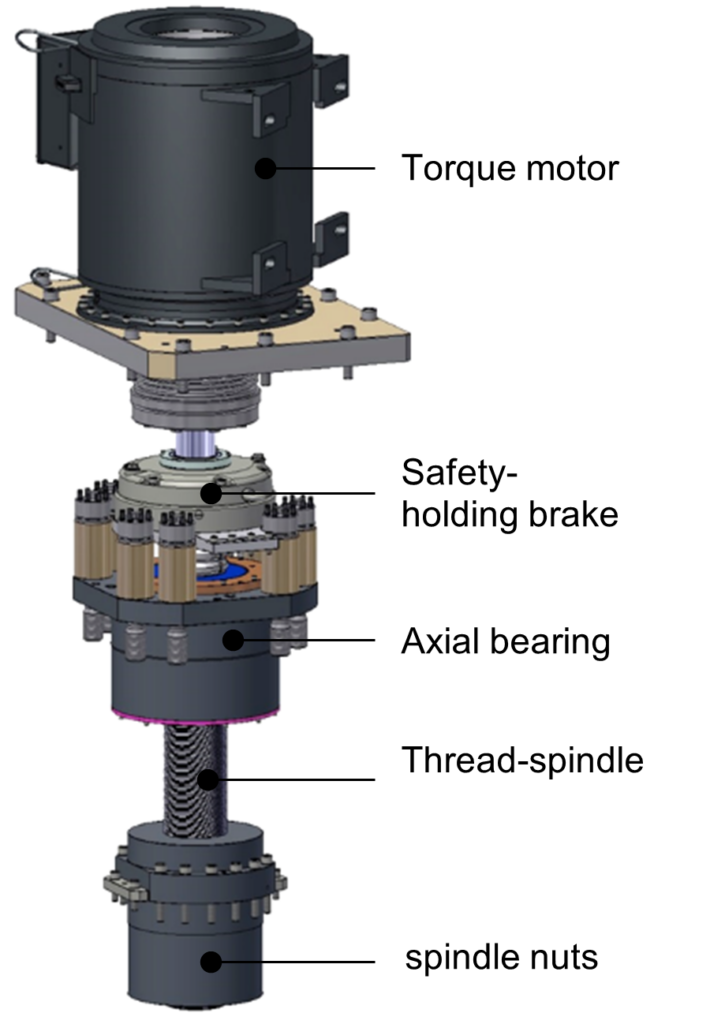
The heart of any servo spindle press is its integrated servo drive system, which consists of high-torque servo motors, precision ball screws or planetary gearing, and advanced control electronics. These components work together to convert electrical energy into precise mechanical motion, eliminating the need for the flywheel and clutch assemblies found in mechanical presses.
All of HTPTs servo spindle press technology incorporates closed-loop feedback systems that continuously monitor position, velocity, and force throughout the forming cycle. Linear encoders and load cells provide real-time data to the control system, enabling immediate adjustments to maintain optimal forming conditions. The control architecture typically includes programmable logic controllers (PLCs) integrated with human-machine interfaces (HMIs), allowing operators to modify press parameters without mechanical adjustments.
Additional components include regenerative drive systems that capture energy during the return stroke, advanced safety systems with predictive monitoring capabilities, and modular tooling interfaces designed for rapid changeovers. Together, these elements create a comprehensive manufacturing automation solution that adapts to changing production requirements.
How Servo Spindle Presses Control Metal Forming
Servo spindle presses control metal forming through programmable motion profiles that can be customized for each specific application and material type. The servo drive system allows operators to define precise ram speeds, acceleration rates, and dwell times at any point during the forming stroke, optimizing material flow and reducing stress concentrations.
During operation, the control system continuously monitors forming forces and adjusts parameters in real time to maintain consistent part quality. This dynamic control capability enables techniques such as pulse forming, in which the ram applies multiple controlled impacts to gradually shape the material, and variable-speed forming, in which different segments of the stroke run at optimal speeds for material flow and tool life.
The closed-loop control system ensures that each forming cycle replicates the programmed parameters precisely, compensating for variations in material thickness, hardness, or temperature. This level of control makes servo spindle presses ideal for applications requiring tight tolerances and consistent surface finishes in high-volume production runs.
Precision Advantages Over Mechanical Presses
Precision metal forming reaches new levels with servo spindle technology compared with traditional mechanical press systems. Servo presses can maintain positional accuracy within micrometers throughout the entire stroke, while mechanical presses are limited by the inherent tolerances of cam and linkage systems, which accumulate over time.
The ability to program custom motion profiles eliminates the trade-off between forming speed and precision that characterizes mechanical presses. Servo systems can slow down during critical forming phases to ensure proper material flow, then accelerate through non-critical portions of the stroke to maintain cycle times. This selective speed control reduces springback, improves surface finish, and extends tool life by minimizing impact forces.
Force-control capabilities in servo spindle presses enable load-based forming, in which the press automatically adjusts stroke depth based on actual forming forces rather than predetermined positions. This approach compensates for material variation and helps ensure consistent part dimensions, even when working with materials that have variable mechanical properties.
Energy Efficiency in Servo Press Operations
Servo spindle presses deliver significant energy-efficiency improvements over conventional mechanical press systems through on-demand power consumption and regenerative capabilities. Unlike mechanical presses that continuously consume energy to keep the flywheel rotating, servo systems draw power only during active forming operations, reducing idle energy consumption by up to 50%.
The regenerative drive systems in modern servo presses capture kinetic energy during the return stroke and feed it back into the electrical supply, further reducing overall energy consumption. This regenerative capability is particularly valuable in high-speed operations, where frequent direction changes generate substantial recoverable energy.
Variable-speed operation allows servo presses to optimize energy use for each specific forming application. Complex parts requiring multiple forming stages can benefit from customized speed profiles that minimize energy consumption while maintaining quality requirements. We have developed servo spindle presses that demonstrate these energy-efficient principles, with closed-loop control systems ensuring optimal power management throughout the forming cycle.
Applications Across Manufacturing Industries
Servo spindle press technology is used across diverse manufacturing sectors where precision, flexibility, and efficiency are critical. In automotive manufacturing, these systems excel at forming complex body panels, structural components, and precision fasteners that require consistent dimensional accuracy and surface quality.
The electronics industry leverages servo press capabilities to form delicate components such as connector housings, heat sinks, and precision stampings, where traditional mechanical presses might damage material through excessive impact forces. Appliance manufacturers use programmable motion profiles to optimize forming operations for various materials and thicknesses within the same production line.
Aerospace applications particularly benefit from the force-control and monitoring capabilities of servo spindle systems, where critical components require full traceability and quality documentation. The ability to record and analyze forming data for each part supports quality assurance requirements and enables predictive maintenance strategies. Our Multi-Stage Presses (MSP) combine servo spindle advantages with transfer capabilities, making them ideal for complex, multi-operation forming sequences common in these demanding applications.
In the defense industry, Servo Spindle presses are used to manufacture mid size caliber ranges that have a high emphasis on precision forming and require flexible tooling.
Contact our team on how we can support your specific project.
Related Articles
- DWI vs Transfer Press for Two-Piece Aerosol Can Manufacturing — Which Is Right for Your Line?
- How Do Flywheel Systems Work in Mechanical Press Operation?
- What is a blank in deep drawing?
- What Is a Servo Press and How Is It Different from a Mechanical Press?
- When Does a New Mechanical Press Make More Sense Than a Retrofit?
