

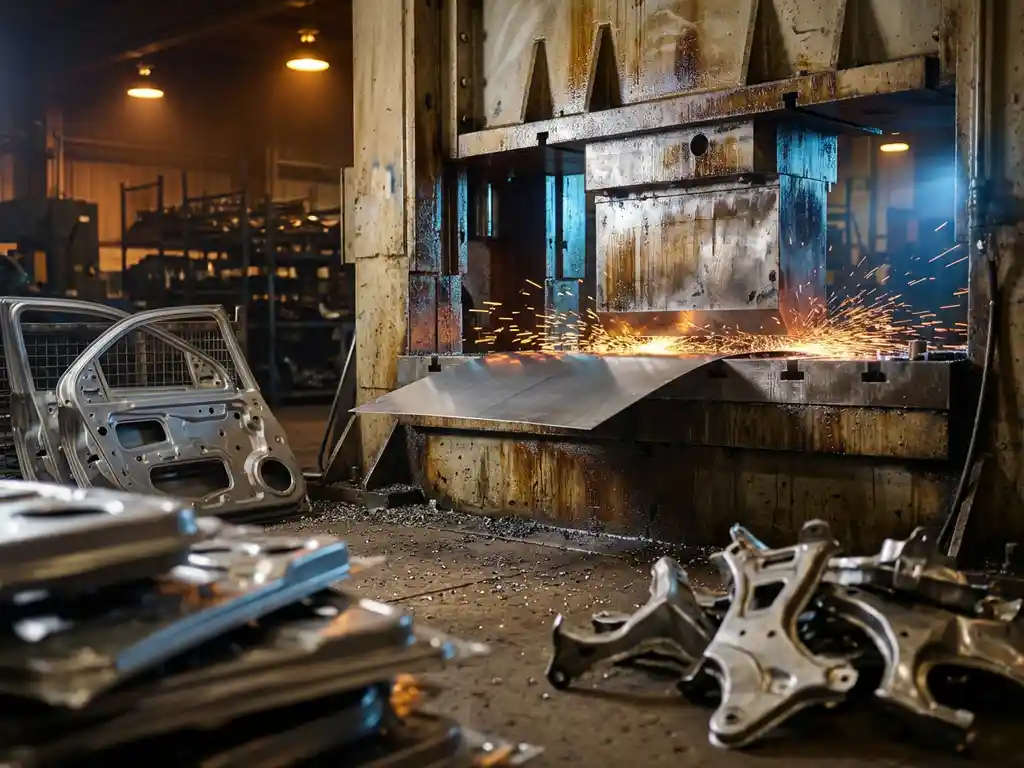
What industries use mechanical presses the most?
The automotive industry leads in mechanical press usage, followed closely by consumer goods manufacturing, appliance production, and electronics manufacturing. These industries rely on mechanical presses for high-volume metal stamping, forming, and fabrication operations that require consistent quality and rapid production cycles.
Rapidely growing is the defense industry. Ammunition as well as military goods are manufactured as well on mechanical presses.
Automotive manufacturers use mechanical presses extensively to produce body panels, chassis components, brackets, and structural parts. The industry’s demand for millions of identical parts makes mechanical presses ideal because of their speed and repeatability. Consumer goods companies depend on these machines to manufacture cookware, metal containers, and household items, while appliance manufacturers use them to create refrigerator panels, washing machine drums, and HVAC components.
The electronics industry also represents a significant user base, employing mechanical presses to produce metal housings, heat sinks, and connector components. The construction and hardware industries round out the major users, using mechanical presses to create fasteners, brackets, and structural elements that require precise forming and consistent dimensional accuracy.
Why does the automotive industry rely so heavily on mechanical presses?
The automotive industry depends on mechanical presses because they deliver the high-speed production, consistent quality, and cost-effectiveness essential for manufacturing millions of vehicle components annually. Mechanical presses can cycle at rates exceeding 200 strokes per minute while maintaining tight tolerances across large production runs.
Automotive manufacturing demands exceptional repeatability for safety-critical components such as structural panels, door frames, and chassis parts. Mechanical presses provide reliable force delivery and precise positioning, ensuring each part meets stringent quality standards. The technology’s proven durability allows continuous operation across multiple shifts, minimizing downtime in automotive production facilities.
Cost considerations also drive the automotive industry’s adoption of mechanical presses. These machines offer lower per-part production costs than alternative forming methods, which is especially crucial in an industry where profit margins depend on efficient, high-volume manufacturing. The combination of speed, reliability, and economic efficiency makes mechanical presses indispensable for automotive metal-forming operations.
What types of products are made using mechanical presses?
Mechanical presses produce a diverse range of metal products, including automotive body panels, appliance components, electronic housings, cookware, coins, jewelry, and industrial fasteners. These machines excel at blanking, punching, forming, and deep-drawing operations across various metal thicknesses and materials.
In automotive applications, mechanical presses create fenders, hoods, door panels, and structural reinforcements. Consumer product manufacturing relies on these machines to produce aluminum cookware, stainless steel sinks, and metal containers. The precision capabilities of mechanical presses make them suitable for creating intricate electronic components such as heat sinks, connector housings, and shielding components.
Industrial applications include manufacturing brackets, clamps, washers, and specialized fasteners that require consistent dimensional accuracy. Demand for mechanical presses has been increasing for the production of metal bellows, cups, and formed profiles where precise geometry and repeatability are critical. The versatility of mechanical press technology allows manufacturers to adapt tooling to diverse product requirements while maintaining production efficiency.
How do different industries choose between mechanical and servo presses?
Industries choose between mechanical and servo presses based on production volume requirements, part complexity, material characteristics, and energy-efficiency goals. High-volume, simple forming operations typically favor mechanical presses, while complex geometries and variable production runs often benefit from the flexibility of servo presses.
Mechanical presses excel in applications requiring maximum speed and the lowest per-part costs, making them ideal for automotive stamping and consumer goods manufacturing. These industries prioritize consistent cycle times and proven reliability over programmable motion profiles. The robust construction of mechanical presses handles demanding applications with minimal maintenance requirements.
Servo presses become advantageous when manufacturers need programmable forming speeds, variable stroke lengths, or precise force control throughout the forming process. Industries producing complex parts with varying wall thicknesses or requiring multiple forming stages within a single stroke often select servo technology. Energy-efficiency considerations also influence the decision, as servo presses can significantly reduce power consumption in applications with varying load requirements, leading to lower operating costs over the machine’s lifecycle.
What are the main advantages of mechanical presses in manufacturing?
Mechanical presses offer superior speed, proven reliability, lower initial investment costs, and exceptional durability for high-volume metal-forming applications. These machines can achieve cycle rates exceeding 200 strokes per minute while maintaining consistent force delivery and precise positioning throughout millions of operating cycles.
The robust mechanical design provides outstanding longevity with minimal maintenance requirements, making mechanical presses ideal for continuous production environments. Their straightforward operation reduces training requirements and simplifies troubleshooting, contributing to higher overall equipment effectiveness. The proven technology offers predictable performance characteristics that manufacturers can rely on for critical production schedules.
Cost advantages extend beyond the initial purchase price to include lower maintenance expenses and reduced complexity compared with servo-driven alternatives. Mechanical presses excel in applications where consistent, repetitive motion produces optimal results, such as blanking, punching, and simple forming operations. The technology’s maturity means readily available replacement parts and widespread service expertise, ensuring minimal production disruptions and extended machine life across diverse manufacturing applications.
How H&T ProduktionsTechnologie helps with mechanical press solutions
H&T ProduktionsTechnologie provides comprehensive mechanical press solutions that address the demanding requirements of modern manufacturing across all major industries. Our expertise delivers:
• High-performance mechanical presses engineered for maximum reliability and speed
• Customized tooling and automation systems tailored to specific production requirements
• Expert consultation on press selection, installation, and optimization
• Comprehensive service support to minimize downtime and maximize productivity
• Advanced safety systems and compliance with international manufacturing standards
Whether you need high-volume automotive stamping solutions, precision forming capabilities for electronics manufacturing, or versatile press systems for consumer goods production, our team provides the technical expertise and proven equipment to optimize your metal-forming operations. Contact our specialists today to discuss how we can enhance your manufacturing capabilities with state-of-the-art mechanical press technology.
