

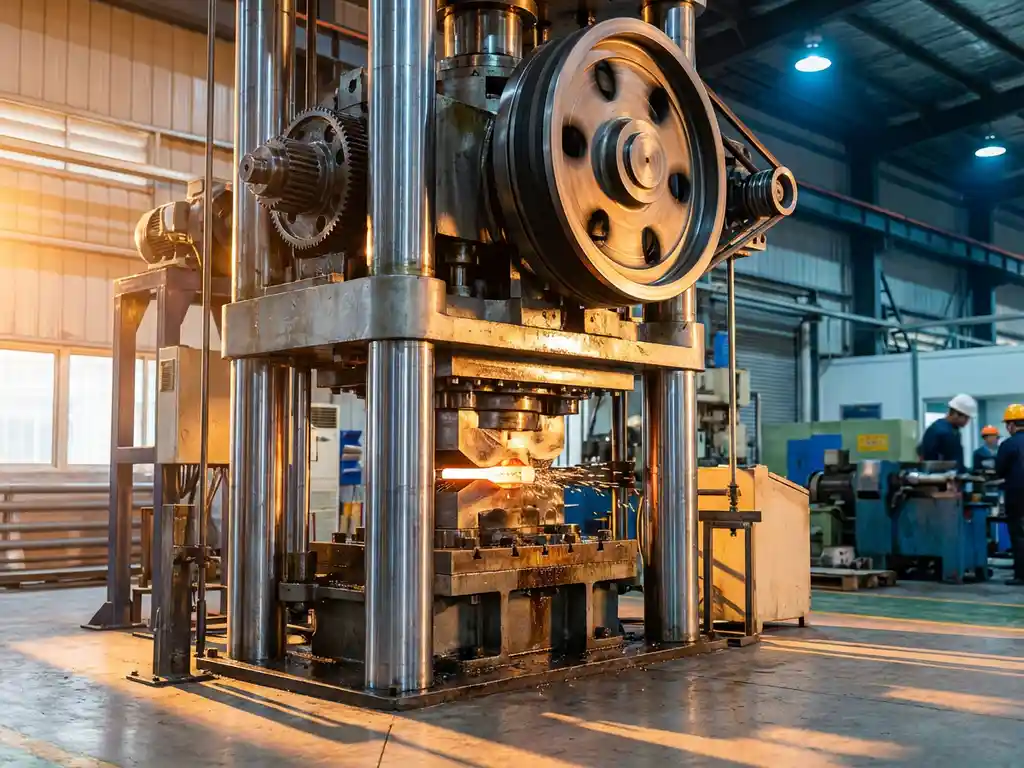
What is a mechanical press, and why is it important?
A mechanical press is a machine tool that uses mechanical force generated by a flywheel-and-crankshaft system to shape, cut, or form metal through the controlled downward motion of a ram or slide.
These versatile manufacturing machines serve as the backbone of modern metal-forming operations across countless industries. Mechanical presses convert rotational energy from an electric motor into linear force, enabling precise control over forming operations while maintaining consistent pressure throughout each stroke. Their importance stems from their ability to deliver reliable, repeatable results at high production speeds, making them essential for automotive stamping, appliance manufacturing, and precision component production.
The significance of mechanical press technology extends beyond basic metal-forming capabilities. These machines offer exceptional durability and can operate continuously for decades with proper maintenance, providing manufacturers with long-term production stability. Their mechanical-advantage systems allow operators to generate tremendous forming forces while consuming relatively modest amounts of energy, contributing to cost-effective manufacturing processes that support competitive pricing in global markets.
How does a mechanical press actually work?
A mechanical press operates by converting rotational motion from an electric motor, through a flywheel-and-crankshaft assembly, into powerful linear motion that drives a ram downward to form metal parts against a stationary die.
The operating cycle begins when the electric motor spins a heavy flywheel that stores kinetic energy during the motor’s continuous rotation. When the operator activates the press, a clutch engages the flywheel to a crankshaft mechanism, which transforms the rotational energy into vertical motion of the press ram. This ram carries the upper die or tooling that shapes the workpiece material positioned on the lower die.
The mechanical advantage created by the crankshaft system multiplies the available force significantly, allowing relatively modest motor power to generate substantial forming pressure. As the crankshaft completes its rotation, the ram returns to its starting position, and the cycle can repeat. Modern mechanical presses incorporate sophisticated control systems that precisely time engagement and monitor press operation to ensure consistent part quality and operator safety throughout production runs.
What’s the difference between mechanical and hydraulic presses?
The primary difference lies in their power-transmission methods: mechanical presses use flywheel energy and crankshaft mechanisms for rapid, fixed-stroke operations, while hydraulic presses employ pressurized fluid systems that provide variable force and stroke control throughout the forming process.
Mechanical presses excel in high-speed production environments where consistent cycle times and rapid part throughput are priorities. Their fixed-stroke characteristics make them ideal for blanking, punching, and forming operations that require precise, repeatable motion patterns. The energy stored in the flywheel allows these machines to deliver maximum force quickly, then complete the forming cycle efficiently.
Hydraulic presses offer superior flexibility for complex forming operations that require variable pressure application or extended dwell times. These systems can modulate force throughout the stroke, making them better suited for deep drawing, compression molding, and applications requiring precise pressure control. However, hydraulic systems typically operate at slower cycle speeds and require more complex maintenance due to their fluid-power components and sealing systems.
Both mechanical and servo technologies are often integrated in modern press systems, combining the speed advantages of mechanical operation with the precision-control benefits typically associated with hydraulic systems, to deliver optimal performance for diverse metal-forming applications.
What types of mechanical presses are available?
Mechanical presses are available in several configurations, including gap frame (C-frame), straight-side, transfer presses, and specialized designs such as cupping presses, each engineered for specific forming operations and production requirements.
Gap Frame and Straight Side Presses
Gap-frame presses feature an open, C-shaped frame design that provides excellent accessibility for loading parts and changing tooling, making them popular for smaller components and moderate production volumes. Straight-side presses use four-column construction that delivers superior rigidity and parallelism, essential for large parts and high-precision forming operations that demand consistent dimensional accuracy.
Transfer and High-Speed Presses
Transfer presses incorporate automated material-handling systems that move parts between multiple forming stations within a single machine, enabling complex, multi-stage operations in continuous production cycles. High-speed transfer systems can achieve remarkable throughput rates while maintaining part quality, which is particularly valuable for automotive and appliance manufacturing applications.
Specialized Mechanical Press Designs
Specialized configurations include double-action presses for deep-drawing operations and vertical cupping presses that efficiently convert metal strips into multiple formed cups in single strokes. Advanced mechanical presses combine blanking and cupping operations into one streamlined process, maximizing production efficiency for cylindrical component manufacturing while maintaining exceptional part quality and material utilization.
How do you choose the right mechanical press for your application?
Selecting the right mechanical press requires evaluating your specific forming requirements, including material type and thickness, part geometry, production volume, tonnage requirements, and available floor space, to match press capabilities with operational needs.
Begin by analyzing your forming operation’s force requirements, which depend on material strength, part size, and forming complexity. Calculate the necessary tonnage by considering the material’s shear strength and the total cutting or forming perimeter. Additionally, evaluate stroke-length requirements to ensure the press can accommodate your tooling setup and part-ejection needs.
Production-volume expectations significantly influence press selection, as high-speed applications benefit from transfer-press systems with automated handling, while lower-volume operations may find single-station presses more cost-effective. Consider future production growth when sizing your equipment to avoid premature capacity limitations that could constrain business expansion.
Technical factors such as shut-height adjustability, bed size, and frame rigidity must align with your tooling requirements and dimensional tolerances. Professional consulting services help manufacturers evaluate these critical parameters, ensuring optimal press selection that maximizes productivity while minimizing life-cycle costs through proper equipment matching and configuration.
How H&T ProduktionsTechnologie helps with mechanical press solutions
H&T ProduktionsTechnologie delivers comprehensive mechanical press solutions tailored to your specific metal-forming requirements, combining decades of engineering expertise with innovative technology to optimize your production capabilities. Our approach ensures you receive the most suitable press system for your applications:
• Custom press design and engineering based on your exact forming specifications and production goals
• Advanced servo-mechanical technology that combines high-speed operation with precise force control
• Specialized cupping press systems that integrate blanking and forming operations for maximum efficiency
• Complete installation, commissioning, and operator training services
• Ongoing technical support and maintenance programs to ensure optimal performance
Contact our engineering team today to discuss your mechanical press requirements and discover how our proven solutions can enhance your metal-forming operations with improved productivity, quality, and cost-effectiveness.
