

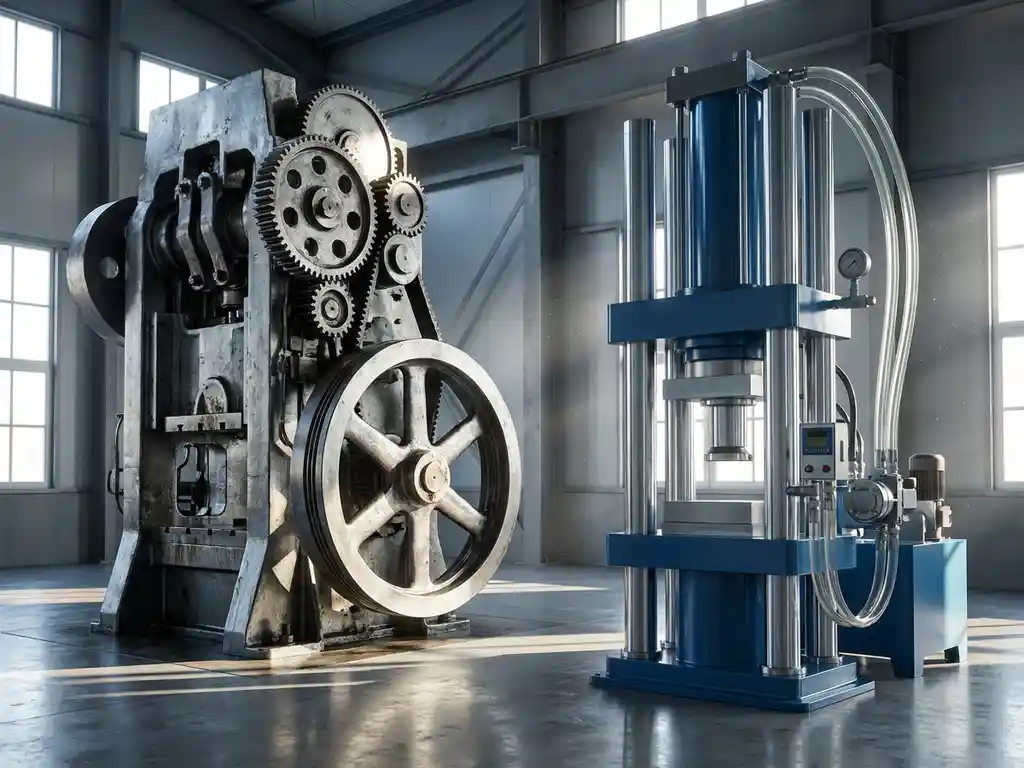
What is the difference between mechanical and hydraulic presses?
Mechanical presses use a flywheel-and-crankshaft system to convert rotational motion into linear force, while hydraulic presses generate force through pressurized fluid acting on pistons. The fundamental difference lies in their power transmission methods and the resulting operational characteristics.
Mechanical presses deliver consistent, high-speed operation with fixed stroke profiles, making them ideal for high-volume production runs. Their flywheel stores energy and releases it rapidly during the forming stroke, creating precise timing and repeatable cycles. In contrast, hydraulic presses offer variable force control throughout the entire stroke, allowing operators to adjust pressure and speed based on specific material requirements.
The choice between these press technologies significantly affects manufacturing efficiency, part quality, and operating costs. Understanding these differences helps manufacturers select the optimal metal-forming equipment for their specific production needs and material specifications.
How do mechanical presses work compared to hydraulic presses?
Mechanical presses operate through a motor-driven flywheel that stores kinetic energy and transfers it via a crankshaft mechanism to create downward force. This system produces a predetermined stroke pattern, with maximum force occurring near the bottom of the stroke.
The mechanical press workflow follows a consistent sequence: the motor accelerates the flywheel during the upstroke, energy accumulates in the rotating mass, and the clutch engages to transfer this stored energy through the crankshaft to the ram. This design creates inherently fast cycle times and excellent repeatability, making mechanical systems particularly effective for blanking, piercing, and forming operations that require consistent force application.
Hydraulic presses function differently by using pressurized hydraulic fluid to move pistons within cylinders. The hydraulic pump pressurizes the fluid, which then acts on the piston to create linear motion and force. This system allows variable force control at any point during the stroke, enabling operators to customize pressure curves for specific forming requirements. The hydraulic approach excels in applications that require deep drawing, compression molding, or operations where force must be maintained for extended periods.
Which is faster: mechanical or hydraulic presses?
Mechanical presses are significantly faster than hydraulic presses, typically achieving 20–1,500 strokes per minute, compared with hydraulic systems, which generally operate at 3–50 strokes per minute. This speed advantage makes mechanical presses the preferred choice for high-volume manufacturing applications.
The speed differential stems from fundamental design differences in how each press technology generates and applies force. Mechanical presses benefit from their flywheel energy storage system, which enables rapid energy release and quick return strokes. The fixed mechanical linkage creates consistent, predictable cycle times that maximize throughput in production environments.
However, speed isn’t the only consideration in press selection. While hydraulic presses operate more slowly, they compensate with superior force control and the ability to maintain pressure throughout the forming process. Some manufacturers prioritize the precision and versatility of servo presses, which combine the speed advantages of mechanical systems with enhanced control capabilities, offering an optimal balance for demanding metal-forming applications.
What are the cost differences between mechanical and hydraulic presses?
Mechanical presses typically have lower initial purchase costs and reduced operating expenses than hydraulic presses of similar tonnage capacity. The simpler mechanical design requires fewer components and less complex maintenance, resulting in a lower total cost of ownership for high-volume applications.
Initial investment costs favor mechanical systems due to their straightforward construction using proven flywheel and crankshaft technology. These presses require less sophisticated control systems and fewer precision-manufactured components than their hydraulic counterparts. Additionally, mechanical presses consume energy more efficiently during operation, as they draw power primarily during the forming stroke rather than continuously to maintain hydraulic pressure.
Operating costs also tend to favor mechanical systems in high-production environments. Maintenance requirements are generally simpler, focusing on lubrication and wear-component replacement rather than hydraulic fluid management, seal replacement, and pump maintenance. However, hydraulic presses may prove more cost-effective for specialized applications that require variable force control or longer dwell times, where their operational flexibility can reduce setup costs and improve part quality.
When should you choose mechanical presses over hydraulic presses?
Choose mechanical presses when your application prioritizes high-speed production, consistent cycle times, and cost-effective operation for repetitive forming tasks. Mechanical systems excel in blanking, piercing, shallow drawing, and stamping operations where speed and repeatability matter more than force variability.
Mechanical presses are particularly well-suited for automotive component manufacturing, appliance-parts production, and consumer goods, where high volumes justify the investment in dedicated tooling. Their fixed stroke characteristics work well for operations with well-defined material-flow requirements and established process parameters. Industries that require tight tolerances with minimal variation between parts benefit from the inherent consistency of mechanical drive systems.
Consider mechanical press technology when your production schedule demands maximum throughput and your forming operations don’t require variable force profiles during the stroke. Evaluating servo press options for applications that need the speed of mechanical systems combined with enhanced process control is recommended. These advanced systems provide the reliability and speed advantages of traditional presses while offering improved energy efficiency and diagnostic capabilities that optimize long-term performance.
How H&T ProduktionsTechnologie helps with mechanical press solutions
H&T ProduktionsTechnologie provides comprehensive mechanical press solutions that address the specific challenges of high-volume metal forming operations. Our expertise spans the complete spectrum of press technology, from initial consultation to implementation and ongoing support.
Our mechanical press solutions include:
- Custom-engineered mechanical presses designed for your specific tonnage and speed requirements
- Advanced servo press systems that combine mechanical speed with hydraulic-like control
- Comprehensive tooling design and manufacturing services
- Process optimization consulting to maximize throughput and part quality
- Preventive maintenance programs that minimize downtime and extend equipment life
Whether you need to increase production capacity, improve part consistency, or reduce operating costs, contact H&T ProduktionsTechnologie today to discuss how our mechanical press expertise can optimize your metal forming operations.
