

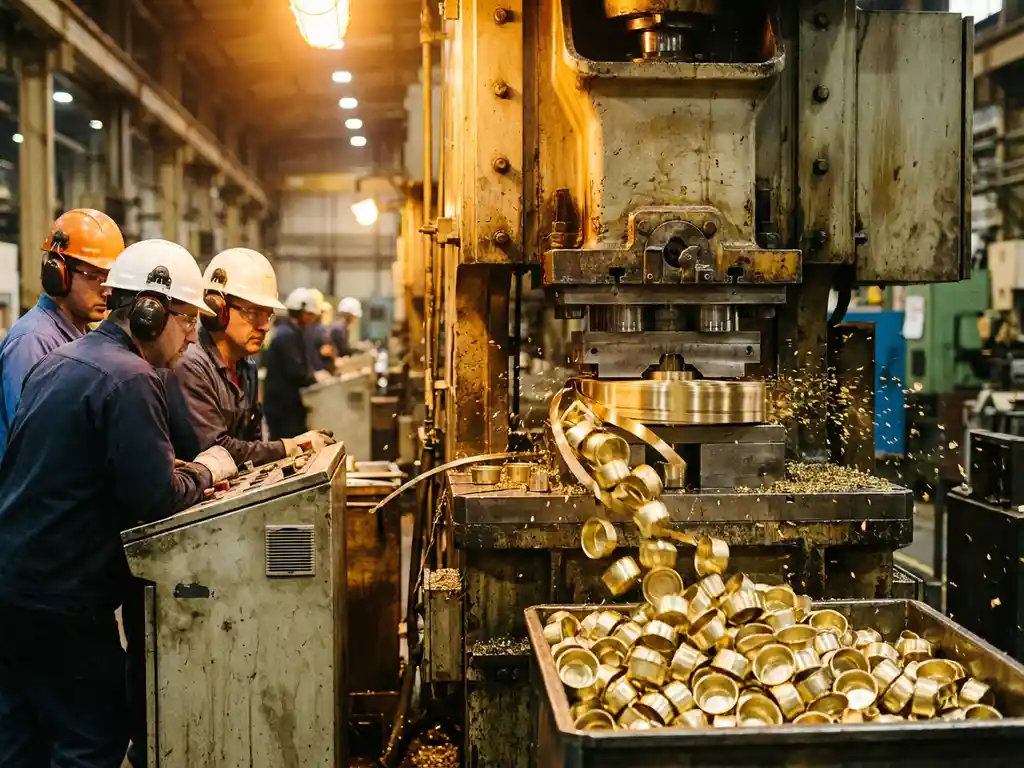
What are the capacity limits of mechanical presses for high-volume production?
Mechanical presses can support high-volume production, with capacities ranging from hundreds to thousands of parts per hour, depending on press size, part complexity, and material thickness. Modern mechanical press systems achieve stroke rates of 20–200 strokes per minute, making them well suited to mass-production applications in automotive, consumer goods, and industrial components.
Actual production capacity depends on several key factors, including press tonnage, die complexity, and material-handling systems. Large mechanical presses with tonnages exceeding 1,000 tons can perform heavy-duty stamping operations while maintaining consistent cycle times. For lighter applications, smaller mechanical presses often deliver higher stroke rates, maximizing throughput for high-volume runs.
Transfer systems significantly expand capacity by enabling continuous material flow through multiple forming stations. These integrated solutions allow manufacturers to complete complex, multistage operations without manual intervention, substantially increasing overall production efficiency and reducing labor costs per part.
How do mechanical presses compare to servo presses for high-volume manufacturing?
Mechanical presses excel in high-volume manufacturing thanks to their robust construction, consistent cycle times, and lower operating costs per part, while servo presses offer superior precision, programmable motion profiles, and energy efficiency. Both technologies can serve high-volume production effectively, but mechanical presses typically provide better cost-per-part economics for straightforward stamping operations.
Mechanical presses deliver consistent power throughout the stroke, making them ideal for applications requiring maximum force and reliability. Their simpler mechanical drive systems result in lower maintenance requirements and reduced downtime—critical factors in high-volume production environments where every minute of operation counts.
Servo presses offer advantages in applications requiring variable speed control, complex forming profiles, or frequent changeovers. Many manufacturers combine both technologies in their manufacturing solutions, offering ServoSpindlePress systems that integrate servo precision with mechanical reliability to deliver optimized performance for diverse high-volume production requirements.
What factors affect mechanical press efficiency in high-volume operations?
Mechanical press efficiency in high-volume operations depends primarily on material-handling automation, die design optimization, proper maintenance scheduling, and integrated quality-control systems. Automated feeding and ejection systems eliminate manual-handling bottlenecks, while well-designed progressive dies maximize material utilization and minimize cycle times.
Die design plays a crucial role in maintaining consistent production speeds and part quality. Progressive dies that combine multiple forming operations reduce handling time between stations, while proper die maintenance prevents unexpected downtime that can halt entire production lines. Material-flow optimization ensures continuous operation without interruptions for stock replenishment.
Preventive maintenance programs significantly affect overall efficiency by preventing unexpected breakdowns during critical production runs. Modern mechanical presses benefit from predictive maintenance technologies that monitor key components and alert operators to potential issues before they cause production delays. Energy-management systems also contribute to efficiency by optimizing power consumption during peak production periods.
When should manufacturers choose transfer presses over single-station mechanical presses?
Manufacturers should choose transfer presses over single-station mechanical presses when producing complex parts that require multiple forming operations, running volumes that justify automation investment, or needing consistent part quality across multistage operations. Transfer presses become economically advantageous when production volumes exceed 100,000 parts annually for multi-operation components.
Transfer press systems excel in applications where parts require blanking, drawing, piercing, and trimming operations in sequence. These integrated systems maintain precise part positioning throughout the forming process, ensuring dimensional accuracy that would be difficult to achieve with multiple single-station presses and manual part transfer.
The decision often depends on part complexity and production-volume economics. Simple, single-operation parts may not justify transfer press investment, while complex automotive components benefit significantly from the automation and consistency that transfer systems provide. Manufacturers should evaluate their specific production requirements to determine the most cost-effective press technology for their applications.
How can manufacturers maximize mechanical press uptime in high-volume production?
Manufacturers maximize mechanical press uptime through predictive maintenance programs, proper operator training, rigorous die maintenance, and integrated monitoring systems that detect potential issues before they cause production stops. Scheduled maintenance during planned downtime prevents unexpected failures that can halt high-volume production lines for extended periods.
Operator training ensures proper press operation and early identification of potential problems. Well-trained operators recognize unusual sounds, vibrations, or performance changes that indicate developing issues. This early detection allows maintenance teams to address problems during scheduled breaks rather than during critical production runs.
Die maintenance programs are essential for sustained uptime, as die-related issues account for a significant percentage of unplanned downtime in high-volume operations. Regular die inspection, proper storage, and systematic reconditioning help maintain consistent part quality while preventing catastrophic die failures that can damage both the die and the press.
Modern monitoring systems provide real-time data on press performance, enabling proactive maintenance decisions. These systems track key parameters such as tonnage, stroke timing, and energy consumption, helping manufacturers optimize maintenance schedules and maximize productive operating time across their press operations.
How H&T ProduktionsTechnologie maximizes mechanical press performance for high-volume production
H&T ProduktionsTechnologie delivers comprehensive solutions that optimize mechanical press performance for high-volume manufacturing through advanced engineering, integrated automation, and ongoing support services. Our approach addresses the critical factors that determine production success:
- Custom-engineered mechanical presses designed for specific production requirements and volume targets
- Integrated transfer systems and automation solutions that maximize throughput while maintaining quality
- Predictive maintenance programs and monitoring systems that minimize unplanned downtime
- Comprehensive operator training and technical support to ensure optimal press performance
- Die design consultation and optimization services for maximum efficiency
Ready to maximize your high-volume production capabilities? Contact H&T ProduktionsTechnologie today to discuss your specific requirements and discover how our mechanical press solutions can transform your manufacturing operations.
