

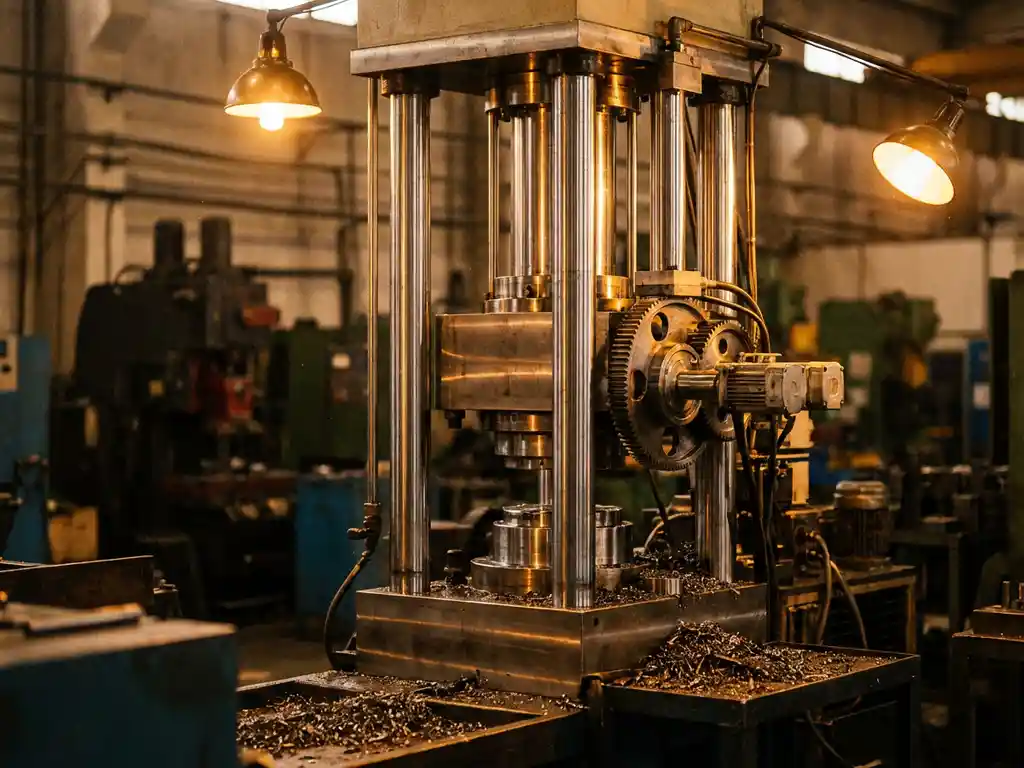
What is a mechanical press, and how does it work in manufacturing?
A mechanical press is a machine tool that uses mechanical force to shape, cut, or form materials through the vertical movement of a ram powered by a flywheel and clutch system. The press converts rotational energy from an electric motor into linear force, delivering precise, repeatable strokes for metal forming and stamping operations.
The fundamental operation begins with an electric motor that spins a large flywheel, storing kinetic energy. When activated, a clutch engages the flywheel with a crankshaft or eccentric shaft, converting rotational motion into the up-and-down movement of the ram. The ram carries the upper tooling, which works against the lower tooling to shape the workpiece. The mechanical advantage created by the flywheel system allows these presses to deliver tremendous force while maintaining consistent cycle times, making them ideal for high-volume manufacturing press applications.
What are the different types of mechanical presses available?
Mechanical presses come in several configurations, including gap-frame (C-frame), straight-side, and specialized designs such as cupping presses, each engineered for specific manufacturing equipment applications. The main types differ in frame construction, force delivery, and operational capabilities.
Gap-frame presses feature an open, C-shaped frame that provides easy access for loading materials and removing finished parts, making them popular for smaller stamping operations. Straight-side presses offer superior rigidity with their closed-frame design, distributing forces evenly across four columns for precision work requiring tight tolerances. Transfer presses automate part movement between multiple stations, enabling complex forming sequences in a single machine cycle.
Specialized cupping presses combine blanking and cupping operations in vertical, double-action machines. These industrial press systems efficiently convert wide metal strips into multiple high-quality cups in a single stroke, optimizing material usage and production efficiency for demanding applications.
How do you determine the right tonnage for your manufacturing needs?
The required tonnage depends on material properties, part geometry, and forming operations. It is calculated by multiplying the material’s shear strength by the total cutting or forming perimeter. Most metal stamping press applications require 20–30% additional capacity beyond the calculated minimum to ensure consistent quality and accommodate material variations.
For cutting operations, multiply the material thickness by the cut length and the material’s shear strength. Deep drawing and forming operations require more complex calculations that consider material flow, draw ratios, and blank-holder forces. Engineers must also factor in safety margins, as operating near maximum tonnage can lead to premature wear and quality issues.
Consider your future production needs when selecting tonnage capacity. While oversizing increases initial costs, it provides flexibility for new products and materials. Conversely, undersized presses may struggle to maintain consistent quality and may experience accelerated wear when pushed beyond optimal operating ranges.
What factors should you consider when selecting press speed and stroke length?
Press speed selection balances production throughput with part quality, while stroke length must accommodate your deepest forming operation plus adequate clearance for tooling and material handling. Optimal speeds typically range from 20 to 200 strokes per minute, depending on material thickness and forming complexity.
Material properties significantly influence speed selection. Thicker materials and complex geometries require slower speeds to prevent tearing or wrinkling, while simple blanking operations on thin materials can run at higher speeds. The forming process itself also dictates requirements: deep drawing needs controlled speeds for proper material flow, whereas piercing operations can run much faster.
Stroke length affects both the types of parts you can produce and cycle efficiency. Variable-stroke capability provides flexibility for different part families, while fixed-stroke presses offer simpler, more robust construction. Consider your tooling requirements, material feed systems, and part ejection needs when evaluating stroke specifications for your production press applications.
How do modern servo technologies compare to traditional mechanical presses?
Servo presses offer programmable motion profiles, variable speed control, and precise positioning throughout the stroke, while traditional mechanical presses provide fixed sinusoidal motion at constant speeds. Servo technology enables optimized forming processes, reduced energy consumption, and greater flexibility for diverse part requirements.
Traditional mechanical presses excel in high-volume, consistent applications, where their robust construction and proven reliability deliver decades of dependable service. Their flywheel energy storage provides excellent force characteristics for cutting and piercing operations, while simpler controls reduce complexity and maintenance requirements.
Modern ServoSpindlePress technology combines the precision of servo control with mechanical reliability, providing unmatched control over plate geometry while maintaining energy efficiency. This hybrid approach delivers the programmability advantages of full servo systems while retaining the proven mechanics that ensure long service life and process stability across demanding automotive and technical component applications.
What maintenance requirements should influence your press selection?
Maintenance requirements vary significantly between press types. Mechanical presses typically require regular lubrication, clutch/brake adjustments, and flywheel inspections, while servo systems require more sophisticated electrical diagnostics but have fewer mechanical wear components. Consider your facility’s maintenance capabilities and downtime tolerance when making your selection.
Traditional mechanical presses require routine maintenance of clutch and brake systems, regular lubrication of mechanical components, and periodic inspection of wear parts such as gibs and bushings. However, their mechanical simplicity means most maintenance tasks can be performed by standard maintenance personnel with basic mechanical skills.
Servo-driven systems shift the maintenance focus toward electrical components, drives, and feedback systems, requiring more specialized technical knowledge but often resulting in longer intervals between major overhauls. Integrated diagnostics in modern press technology can predict maintenance needs and optimize service schedules, helping minimize unexpected downtime and maximize equipment investment.
How H&T ProduktionsTechnologie helps with mechanical press solutions
H&T ProduktionsTechnologie provides comprehensive mechanical press solutions tailored to your specific manufacturing requirements, combining decades of engineering expertise with cutting-edge technology. Our approach ensures optimal productivity and quality for your metal forming operations:
• Custom-engineered press systems designed for your exact tonnage, speed, and stroke requirements
• Advanced ServoSpindlePress technology that delivers precision control with mechanical reliability
• Specialized cupping presses that maximize material efficiency and production throughput
• Comprehensive after-sales service and maintenance programs to minimize downtime
• Expert consultation to help you select the ideal press configuration for current and future needs
Ready to optimize your manufacturing processes with the right mechanical press solution? Contact our engineering team today to discuss your specific requirements and discover how our proven press technologies can enhance your production capabilities.
