

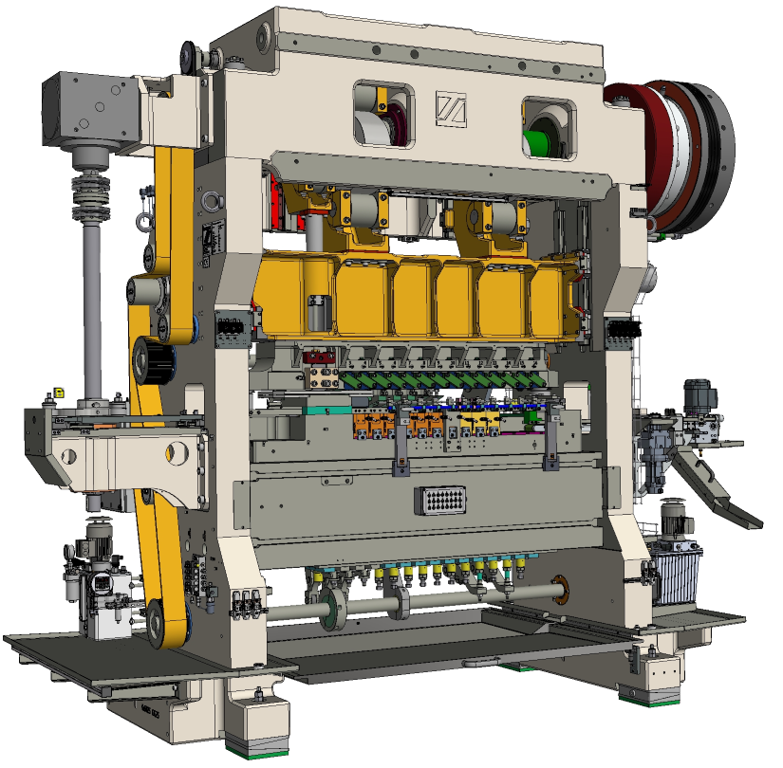
What are mechanical presses, and how do they work?
Mechanical presses are manufacturing machines that use a flywheel energy storage system combined with a clutch-and-brake mechanism to deliver controlled force for metal-forming operations. These industrial presses convert rotational motion from an electric motor into linear pressing force through a crankshaft or eccentric-shaft system.
The fundamental operation begins when an electric motor spins a large flywheel that stores kinetic energy. When a pressing cycle begins, a clutch engages to transfer this stored energy through a gear-reduction system to the crankshaft. The crankshaft converts rotational motion into the up-and-down movement of the ram, which carries the upper tooling. This mechanical advantage allows the press to deliver tremendous force during the forming stroke, with maximum tonnage typically occurring near the bottom of the stroke, where metal-forming operations require the greatest pressure.
The energy-storage principle makes mechanical presses particularly effective for high-volume production runs. Unlike hydraulic systems, which generate force on demand, the flywheel continuously accumulates energy between strokes, enabling rapid cycling and consistent performance across thousands of operations.
Why are mechanical presses more cost-effective than other press types?
Mechanical presses offer superior cost-effectiveness due to their lower initial purchase price, reduced energy consumption, and minimal maintenance requirements compared with hydraulic or servo-driven alternatives. Their simple mechanical design, with fewer complex components, translates directly into lower acquisition costs and operating expenses.
Energy efficiency represents a significant cost advantage for mechanical press technology. The flywheel energy storage system consumes power primarily during acceleration, whereas hydraulic presses run pumps continuously, and servo presses require continuous power for precise positioning. This fundamental difference can result in 30–50% lower energy costs during high-volume production runs. Additionally, mechanical presses require less sophisticated control systems and fewer electronic components, reducing both initial investment and long-term maintenance expenses.
The durability of mechanical press systems further enhances their cost-effectiveness. With proper maintenance, these robust machines can operate reliably for decades, providing an excellent return on investment. Their straightforward mechanical operation means fewer specialized technicians are needed for routine maintenance, and replacement parts are typically more affordable and readily available than complex hydraulic or electronic components.
What production advantages do mechanical presses offer manufacturers?
Mechanical presses deliver exceptional production advantages through high-speed operation, consistent cycle times, and reliable performance that maximizes manufacturing throughput. These machines can achieve stroke rates of 100–300 strokes per minute, significantly outpacing hydraulic alternatives for high-volume applications.
Consistent energy delivery from flywheel systems helps ensure uniform part quality across extended production runs. Unlike hydraulic presses, which may experience pressure variations, or servo systems, which require complex programming, mechanical presses provide predictable force curves that maintain dimensional accuracy throughout the manufacturing process. This reliability reduces scrap rates and minimizes quality-control issues that can disrupt production schedules.
Rapid changeover capabilities represent another key production advantage. Mechanical presses typically feature simpler tooling setups and fewer adjustment parameters than more complex press technologies. Manufacturers can often complete die changes and resume production faster with mechanical systems, reducing downtime between different part runs. The mechanical design also provides excellent process stability, maintaining consistent performance even in demanding automotive and consumer-goods manufacturing applications.
How do mechanical presses improve metal-forming precision?
Mechanical presses achieve superior metal-forming precision through predictable force delivery, rigid frame construction, and consistent stroke characteristics that eliminate variables common in other press technologies. The mechanical linkage system provides repeatable motion profiles that ensure identical forming conditions for each part.
This inherent precision stems from the direct mechanical connection between the drive system and ram movement. Unlike hydraulic systems, where pressure fluctuations can affect forming force, or servo systems, where electronic control can introduce variability, mechanical presses deliver force through solid mechanical components. This direct mechanical advantage creates consistent tonnage curves and eliminates compliance issues that can compromise dimensional accuracy in other press types.
Frame rigidity plays a crucial role in precision metal-forming operations. Mechanical presses typically feature robust cast-iron or welded-steel frames designed to handle maximum rated tonnage without deflection. This structural integrity maintains precise tool alignment throughout the forming stroke, preventing angular variations that can cause dimensional inconsistencies. The combination of predictable kinematics and solid construction enables mechanical presses to achieve tight tolerances repeatedly, making them ideal for applications requiring consistent part geometry across high-volume production runs.
When should manufacturers choose mechanical presses over servo technology?
Manufacturers should choose mechanical presses over servo technology when prioritizing high-volume production, cost-effectiveness, and straightforward operation over programmable flexibility. Mechanical presses excel in applications requiring consistent, repetitive operations with established forming parameters rather than frequent program changes or complex motion profiles.
High-volume manufacturing scenarios represent the ideal application for mechanical press technology. When producing thousands of identical or similar parts, the speed and energy-efficiency advantages of mechanical systems outweigh the programming flexibility offered by servo technology. Industries such as automotive stamping, appliance manufacturing, and consumer-goods production benefit most from mechanical presses due to their predictable production requirements and emphasis on cost per part.
Mechanical presses also prove superior when operational simplicity takes priority over advanced features. Manufacturing environments with limited technical support staff, or those requiring minimal operator training, often find mechanical systems more practical than complex servo-driven alternatives. Additionally, applications with established tooling and proven forming processes may not require the programmable motion profiles that justify servo technology’s higher investment. Mechanical presses are recommended for manufacturers focused on maximizing throughput and minimizing operational complexity rather than pursuing advanced process-control capabilities.
How H&T ProduktionsTechnologie helps with mechanical press solutions
H&T ProduktionsTechnologie provides comprehensive mechanical press solutions that address the specific challenges manufacturers face in high-volume metal-forming operations. Our expertise delivers measurable benefits through:
- Custom-engineered mechanical press systems optimized for your specific production requirements and tonnage needs
- Advanced flywheel energy storage designs that maximize efficiency while reducing operational costs
- Precision frame construction and tooling integration for consistent part quality and dimensional accuracy
- Complete installation, commissioning, and ongoing technical support to ensure optimal performance
Whether you’re upgrading existing equipment or implementing new production lines, our mechanical press solutions combine proven technology with modern engineering to deliver the reliability and cost-effectiveness your operations demand. Contact us today to discuss how we can optimize your metal-forming processes with the right mechanical press solution for your manufacturing goals.
